THE VINEYARD
Geneva has been famous for millennia for the production of its local wines, which have gone on to become renowned AOCs. With nearly 1,400 hectares of vineyards, it’s fair to say that the city famous for its Jet d’Eau fountain knows a thing or two about wine.
It is, in fact, the country’s third-largest wine-producing canton. The families of winegrowers who work with La Cave de Genève offer a wide range of wines: some are gourmet, others light, intense, rare or easy-drinking.
BETWEEN ARVE AND LAKE
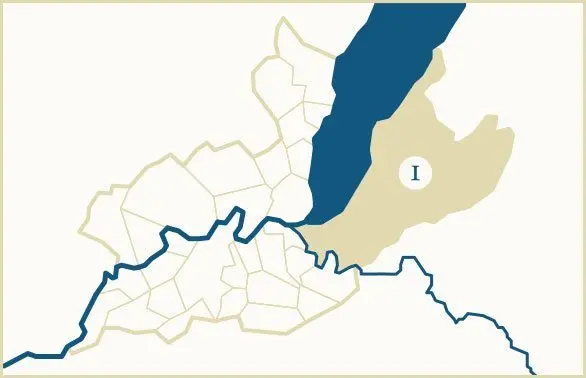
Covering nearly 283 hectares, the region known as ‘between the Arve and the Lake’ stretches from Cologny to Hermance and includes, to name but a few, the hillsides of Meinier, Choulex and Jussy. Geographically, it opens out to the east and forms a large triangle bordering the left bank of Lake Geneva, extending as far as the French border near Jussy.
Offering exceptional panoramic views of the Alps and the Salève, this terroir benefits from a microclimate: under the influence of thermal currents from the Alps, this microclimate promotes the ripening of the grapes and the development of their aromas.
MANDEMENT
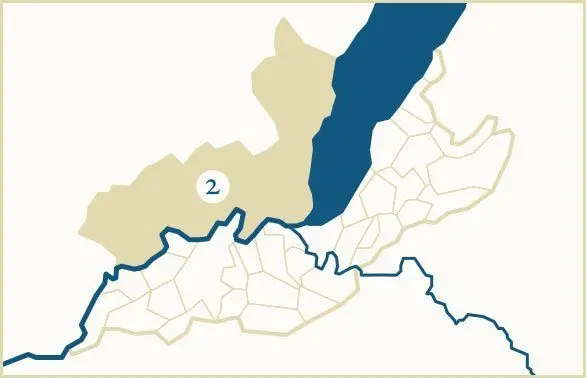
Covering 790 hectares, the Mandement region is the largest of Geneva’s three wine-growing regions on the right bank. Not far from the city centre, nestled in the heart of the countryside, lies Satigny, Switzerland’s largest wine-growing municipality, with no fewer than 480 hectares.
The Geneva wine-growing region is characterised mainly by clay soils with varying degrees of gravel, lying on ancient glacial moraines. Some areas – particularly in the Peissy region – are situated on very hard and dense molasse-type rock.
BETWEEN ARVE AND RHÔNE
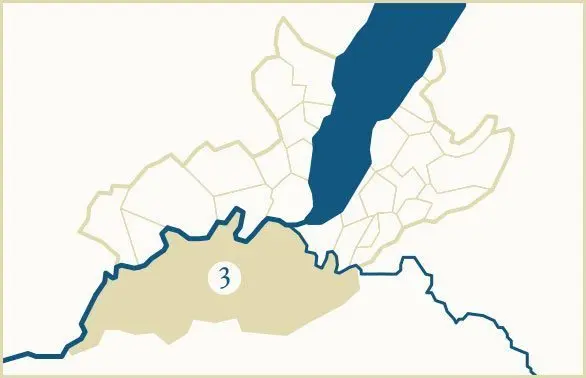
Comprising around twenty wine-growing communes, this region stretches from the banks of the Rhône to the foot of the Salève. The fertility of its soil is due to the prehistoric glacial moraines that eroded Mont Blanc. The region’s limestone-rich, gravelly soil lends the grapes grown there finesse and elegance.